

S I N G A
singing maditaion
「 We gently remember that we are living one life 」


About SINGA
S I N G A – singing meditation – is a form of meditation using voice and music.
It helps you reconnect with your own divinity and experience your true self.
It offers a practical way to activate your natural life potential and let your original human nature blossom.

Core of SINGA
The core of SINGA is a simple practice of using your voice together with music.
By gently swaying your body and sounding vowel tones with the music, you release tension throughout your body and help to calm an overactive mind (overthinking and mental chatter).
When you practise with a clear intention, your whole state of being comes into balance, and a peaceful, creative state of body and mind naturally begins to appear.
SINGA was first used privately by its founders, Shinta Sakamoto and Mai Sakamoto. Since 2018, they have used it as a daily practice to dive more deeply into themselves during the process of making music.
Later, they felt called to share this practice beyond the frame of music production, as a simple and practical way for anyone to experience the richness of living from inner peace. From this wish, SINGA was born.


3 MOVEMENT
Three wisdom of SINGA
-
We begin with a gentle guided movement called Yura-Yura before entering SINGA.
This movement helps to awaken the body’s natural, unconscious movements, sometimes called spontaneous or involuntary movement. At first, you intentionally sway your body and focus on what feels good. You can stretch, shake, or lightly rub different parts of your body as you like.
As you continue, your body may start to respond on its own. You might yawn, tear up, or have a runny nose. After a while, your body may begin to move before you “decide” to move it. Unusual or unexpected movements can appear – movements you would not normally do in daily life.
By allowing and trusting these movements, the body’s own self-adjusting function starts to work.
From this open, receptive state – listening to the sensations rising from the body – we then move into the vocal part of SINGA.
-
With music playing, we gently sway the body and begin by sounding “n”.
From there, we move into the Japanese vowel sounds: u – o – a – e – i.By continuing to sound these vowels – simple sounds without meaning – we step out of the world of “meaning” and into a space beyond words.
Through this, we shift from a mind dominated by separation and judgement to a more creative and integrated state of awareness.
When we are released from our usual judging mind – the identity that has been strengthened by repeated thoughts and emotions from the past – a different kind of energy begins to rise from within: a raw, non-judging life force.
As this life force overflows, our natural self-healing ability, creativity, and inborn talents can start to show themselves. This is one of the main aims of the practice.
-
In the “Ku Haku” where we taste silence, we rest in the open, empty moment that comes just after sounding the vowels with the music.
When we touch this clear, ego-free sense of our true self in a deep meditative state, the body’s natural healing power and the rewriting of old belief patterns begin to work on their own. Creative ideas can then appear more easily and without resistance.
On a bodily level, a feeling of lightness and freedom can arise. You may forget your old sense of “me” and feel a fresh, renewed version of yourself.
This is not so much becoming a new person as meeting a more true, as-you-are version of yourself – something that feels both new and deeply familiar at the same time.
As a result, a peaceful and creative inner environment is cultivated – a right-brain, intuitive state in which the talents and abilities once limited by your own thoughts, beliefs, and habits can more easily blossom. From there, a life based on safety and joy can open up, as you feel your connection with life and with the world around you.
ABOUT MUSIC
The music used in SINGA is a body of works composed, performed and produced by SINGA’s founders, Shinta Sakamoto and Mai Sakamoto.
Each piece is music played from the state of SINGA, working subliminally on the consciousness of those who practise SINGA and conveying the quality of this state through its shifting breathing rhythms and harmonies.
As this music unfolds the field of the true Self, and as you give vowel voice and resonate with this field, you are able to experience, at a deeper level, a world of felt sense that cannot be fully conveyed by verbal guidance alone.
HOW TO EXPERIENCE

-
This is an online community that is, at the same time, like a dōjō—a place where those who wish to live from their true self can align body and mind through daily SINGA practice—and like a true home where you can completely relax and be at ease.
We are opening this space as a sanctuary in the modern world, where information and thoughts often swirl around us like a storm.
(In salon mainly Japanese Language )

-
It is an online programme designed for those who are new to SINGA – singing meditation.
(Englsih ver will be ready soon)

-
SINGA OS is the most powerful online programme for practising SINGA – singing meditation and embodying a peaceful, creative state of consciousness.
There are two course options:
an intensive 21-day programme
and a 181-day extended programme.
Because it is a fully online, self-paced programme, you can focus deeply and bring out your best performance. It is especially well suited to those who enjoy making steady progress on their own.
(English ver is now construction )
VOICES
Voices from SINGA Participants
「Mai, thank you again for today.
I’m sorry the hotel Wi-Fi was so temperamental and kept cutting out.
At the end I didn’t notice at all when the connection dropped. I simply went on breathing, endlessly observing what was happening in my body. It was quite some time before I realised that the call had actually disconnected.
If I put it in one phrase, it was a miraculous experience. I really cannot find any other word. For me, the fact that I was able to receive this session in Nepal, at exactly this moment in my life, already feels like a miracle in itself.
All the feelings I seem to carry deep inside – doubt about my own existence, anxiety, impatience, fear, sadness – were gradually filled to the brim within the vessel of my body by the shower of words pouring down from above. In the end they overflowed, and I found myself completely held in that overflowing ocean of sound. Then my own voice began to resonate, both inside and outside, and it simply did not stop. A sense of being so full and safe: I don’t need anything else; just being here, now, soaked in this sea of vowel sounds is enough.
That is what it felt like.
From my twenties to my forties I have received a great many forms of bodywork and coaching, and I myself once stood on the “treatment” side. But to drop, in an instant and from the inside, into such a deeply intuitive, right-brain state like this – I was astonished. Completely astonished.
(I still cannot quite find the perfect words, so this may sound clumsy, but “astonished” is what fits best.) I know I will never forget this feeling, and now that I have become aware of it, there is no way I can pretend not to see it.」
「After the SINGA session, my mind became completely quiet, and my usual room seemed brighter, almost shining in pure white. I noticed the tiny dust particles floating in the air, looking almost like little living beings – so cute and beautiful – and I realised my way of seeing had shifted back to something like a child’s perspective.
For the past month or so I had been carrying thoughts like, “I have to try harder,” “I must become a better version of myself.” After the session, it felt as though those layers simply peeled away, and I felt very safe and relieved. I spent the entire day moving slowly, gently. I also slept deeply that night.
I was deeply grateful for the way Shinta stayed close, really listening to my words just as they were. It was truly moving to feel that our inner experiences were synchronised, as if we were sharing the same intention. There is so much more I could write, but for now, thank you from the bottom of my heart.」
「From the moment I heard the piano, a wave of nostalgia rose up and I felt tears welling in my eyes.
I let the vowel sounds resonate as I gave voice to them.
My body began to move, to express, to cry out.
I realised I had always been here, and that this is where I had wanted to return.
After that, all that came were sobs.
Thank you.」
「I feel deeply grateful for what felt like a miracle: being able to let my own voice out so comfortably, without hesitation, in a way that felt truly like myself.
The time passed in an instant. Afterwards, I felt a clear sense of release and could sense my whole body rejoicing.
It even felt as though the way my voice comes out had changed. I could feel the resonance arising from below my throat. Many tears flowed, but it all felt completely natural.
I am truly glad I received this session.
Thank you so much.」
「I’ve always had a complex about my own voice, especially about singing.
In the childhood memories that remain with me, I only remember a version of myself who was already holding back, worrying about what others thought.
To be able to move freely, to let my voice out, to express myself – I realised just how deeply joyful that is. My whole body was overflowing with a sense of joy.
As we went through the work, it felt as though all the sticky layers I had plastered over myself were peeling away, and I was returning to a blank, original version of me.
At one point, I felt that familiar heaviness in both hands that used to appear when my childhood anxiety surfaced. But this time, the anxious feelings did not come. I saw that I had simply been linking that physical sensation and the feeling of anxiety together. I was able to quietly observe this pattern within my own experience.」
「For me, every part of this was a completely new experience, and I was amazed to discover that such sensations even existed.
In my case, a few minutes after the session began, it felt as though a white, hollow pathway opened up in the centre of my body, and my voice was resonating up through it from below.
It was as if a straw had formed right through the middle of my body, piercing it from bottom to top.
The empty, silent time was also something I had never felt before. I do meditate every day, but I encountered a kind of stillness unlike anything I have ever known.
Inside my head, it was exactly like an empty gymnasium – no one there, no sounds, no voices at all.」
「Mai, thank you so much for the SINGA session.
It was a strange, indescribable experience.
Lately, even when I looked at the cherry blossoms, I could see they were beautiful but my heart did not move. My head was so full of noise – my own thoughts and the voices around me – that I couldn’t settle at all. So the biggest surprise was that, in that short time, my thinking simply came to a complete stop.
It wasn’t a feeling of “nothingness”, but more like a calm, windless sea.
It was as if time had stopped only in this space, while the world around me continued to move. I could hear birds calling in the distance and just quietly register, “Ah, they’re singing.”
Wrapped in a sense of happiness and safety, I felt such a gentle peace that I found myself thinking, “Is this the afterlife… heaven, perhaps?”
I could feel the vibration of the sounds I was making, on my skin and from within, and as I swayed and moved, I sensed my body – my very cells – rejoicing.
In the latter half, my movements grew larger; I went barefoot and found myself dancing, almost like in an improvised ballet, savouring the happiness.
I realised just how much a part of me had been longing to make sound, to move, to express itself like this.
Just as you said, that being in a right-brain, intuitive state naturally spreads to those around you, after the session my family were noticeably calmer and gentler than usual. It felt as though the whole world had changed, and that, too, astonished me.
I’m going to keep experimenting with this.
I feel I have been rescued from a state of complete saturation and overwhelm.
Thank you, truly.」
Philosophy・Vision
Philosophy・Vision

Through SINGA – singing meditation – we aim for each person to learn and directly experience simple wisdom and methods for guiding themselves back to inner peace. In this way, we support the natural creation of a society that is based on creativity, coexistence, and joy.
As peace is embodied in each individual, its ripple naturally spreads. Our vision is that, through this, world peace will quietly and organically begin to appear.
YouTube Channel

Founder

-
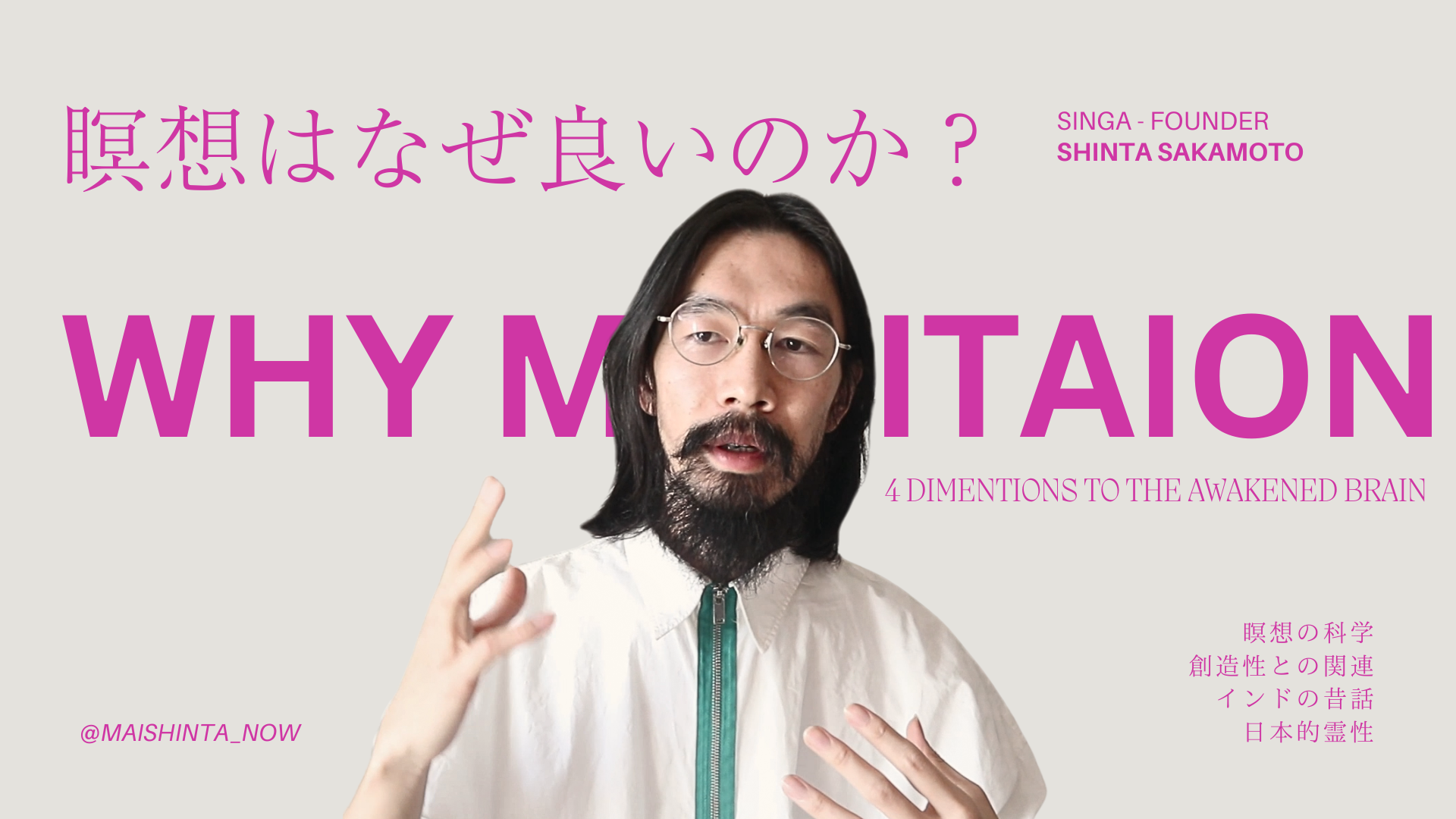
Shinta Sakamoto began playing the piano at the age of three and composing from twelve. While studying at Waseda University’s School of Fundamental Science and Engineering, he co-founded Tokyo Recordings (now TOKA) at the age of 23 with fellow musicians, including Nariaki Obukuro and Yaffle. Since then he has composed and produced music for films, recording artists and television commercials.
In 2015, after the passing of his grandmother, he spent a period in London, where he began to sing his own songs.
In April 2016, he met Mai Mukaida (now Mai Sakamoto), and together they began creating music as a duo. He also founded his own label, 8th MAY Records.
To date, he has released more than 30 albums (over 300 tracks) under the names maishinta and Shinta Sakamoto, including several collections of piano works. Since 2023, the entire catalogue of around 300 tracks from 8th MAY Records has been made available via maishinta music.
In 2024, as a way of connecting his creativity with peace-building, he founded SINGA, a form of “singing meditation”. Placing music at the centre, he continues to explore various projects dedicated to making this world a more peaceful and love-filled place.

-
At the age of fifteen, Mai met a humanitarian worker active in Nepal, and at seventeen she travelled there alone for the first time. Guided by the encounters that followed, she launched the Coffret Project at twenty-six, after graduating from Keio University’s Faculty of Policy Management. The project uses makeup as a way to support and awaken women’s self-esteem.
She later founded the cosmetics brand Lalitpur to support women who have survived human trafficking. As she began to receive more invitations to speak, including at TED, she awakened to the mysterious power of the human voice and started writing and performing her own poetry.
In April 2016, she met Shinta Sakamoto. Because she arrived late to their very first meeting, a song was born in that extra time – HOHOEMI – for which she became the vocalist.
Since then, the two have been active together as maishinta. To date, they have released four albums as maishinta, available at Tower Records stores across Japan and other outlets.
In 2024, together with Shinta, she co-founded SINGA, a form of “singing meditation”. Through the resonance of the voice, she supports people in rediscovering the warm inner feeling of being alive and the direct experience of love that spreads from within.
Author of Living the Beautiful Moment (Discover 21).
